
let’s preserve the environment by using solar panels
Contact Us 
The choice comes down to one question: do you want to own the system or just buy the power? CAPEX means upfront investment, full ownership, accelerated depreciation tax benefits, and the highest long-term savings.
OPEX means a zero upfront cost developer owns and maintains the system while you pay only for the electricity you use through a PPA, giving immediate, risk-free savings. CAPEX wins on lifetime value; OPEX wins on speed and simplicity. The right model depends on your capital, risk appetite, and tax strategy.
This guide is for Indian C&I decision-makers comparing solar financing options. Inside: a side-by-side comparison, tax and balance-sheet implications, real-world examples (electronics manufacturer on OPEX, FMCG brand on CAPEX), and a six-point checklist to decide which fits your business.
– CAPEX involves owning the solar system, requiring upfront investment but offering long-term savings, tax benefits, and full control.
– OPEX requires no upfront cost, as a developer owns the system; businesses pay only for consumed energy through a PPA.
– CAPEX suits companies with available capital, a desire for asset ownership, and plans to use accelerated depreciation benefits.
– OPEX suits businesses seeking quick savings, minimal operational involvement, and zero maintenance responsibility.
– The best choice depends on financial strategy, risk appetite, operational bandwidth, tariff comparison, and sustainability goals.
India’s solar energy sector has witnessed extraordinary growth over the past decade, positioning the country as a global leader in renewable energy development and clean power generation. Driven by ambitious national solar mission targets, rapid solar panel technology advancements, and strong government renewable energy policies in India, solar power has emerged as the backbone of the nation’s sustainable energy transition.
As of 2024, India has installed over 72 GW of solar power capacity, ranking among the top five solar energy producing countries globally. The rapid expansion of utility-scale solar power projects, commercial and residential rooftop solar systems, and large solar parks across India continues to boost green energy production, lower carbon emissions, and reduce the country’s dependence on fossil fuels and imported energy resources.
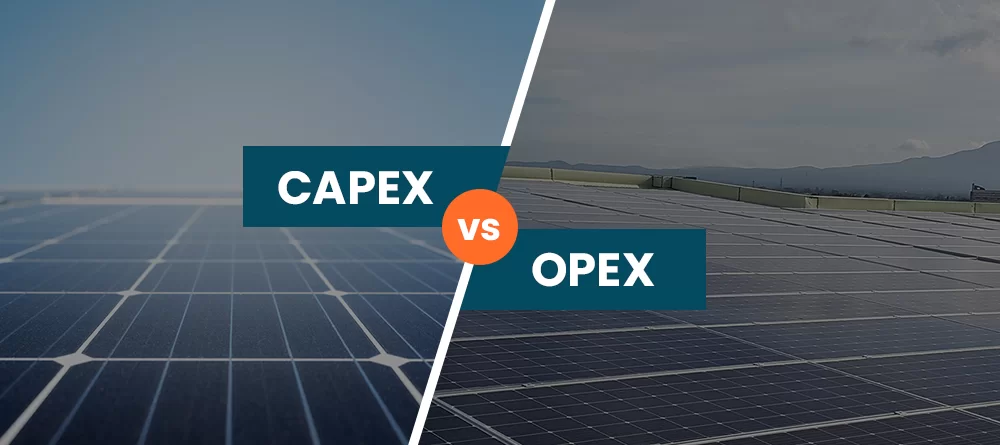
Solar energy adoption, while lucrative in the long run, involves capital-intensive infrastructure. For many C&I consumers, upfront costs, operational risk, and maintenance responsibilities can become barriers to entry. That’s where financing models come in.
Innovative business models like OPEX (Operational Expenditure) and CAPEX (Capital Expenditure) play a pivotal role in scaling solar projects by making them financially feasible and operationally convenient for businesses of all sizes.
These models not only improve the accessibility of solar projects but also allow companies to choose options aligned with their cash flow, risk appetite, and long-term sustainability goals. Let’s explore both models in detail and understand the difference between the CAPEX and OPEX solar models to help you make an informed decision.
Read More: Understanding I-Recs for C&I Power Buyers to Meet Renewable Goals

The CAPEX (Capital Expenditure) model involves purchasing and owning the solar power plant outright. Under this model, the consumer makes a full upfront investment in solar infrastructure installed on their premises. The solar system becomes a fixed asset on the balance sheet, offering advantages such as tax depreciation benefits, long-term cost savings, and complete ownership control over the power generation system.
Key Features of the CAPEX Model:
– Upfront investment by the consumer
– Ownership lies with the consumer
– Eligible for tax benefits like accelerated depreciation
– Suitable for consumers with an adequate capital expenditure budget
– Long-term ROI with reduced electricity bills
Ideal For:
Businesses looking to reduce electricity costs significantly over the long term and willing to invest upfront in infrastructure. It’s also preferred when claiming accelerated depreciation is part of your tax strategy, allowing significant savings in the initial years.
If your financial planning involves asset creation and tax optimization, the CAPEX model may align well with your business goals.
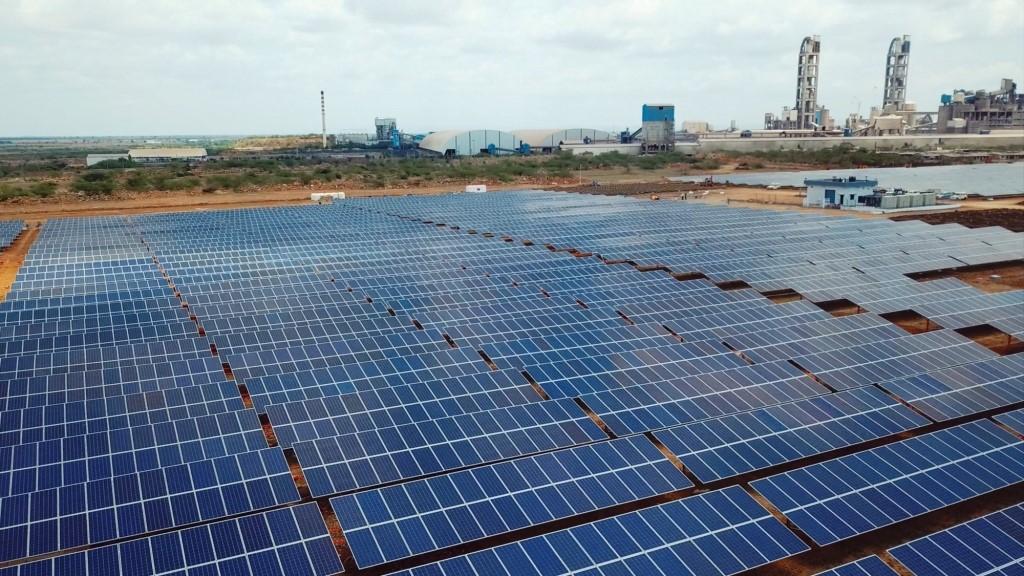
The OPEX (Operational Expenditure) model, also known as the OPEX solar model, is a pay-as-you-go model. In this case, a third-party investor or developer owns the solar plant, and the consumer signs a Power Purchase Agreement (PPA) to buy the electricity generated at a pre-agreed rate.
Key Features of the OPEX Model:
– No upfront capital investment by the consumer
– Ownership remains with the solar developer
– Maintenance and performance risk lies with the service provider
– Consumer pays only for the electricity consumed (per kWh basis)
– Quick implementation with minimal operational involvement
Ideal For:
Businesses that prefer minimal capital investment, are looking for immediate savings, and want a risk-free solar experience. If you’d rather focus on your core business and leave the technicalities to experts, OPEX is a no-brainer.
For more on customized solar financing, explore Enerparc Energy’s OPEX solutions.
Criteria | CAPEX Model | OPEX Model |
| Ownership | Consumer | Third-party Developer |
| Capital Investment | High | None |
| O&M Responsibility | Consumer | Developer |
| Tax Benefits | Available (e.g., accelerated depreciation) | Not applicable to consumers |
| Electricity Tariff | Lower in the long term | Fixed for PPA duration |
| Savings | Higher over the project life | Immediate and moderate |
| Balance Sheet Impact | Asset Addition | Treated as an expense |
| Control & Customization | Full | Limited |
| Scalability | May require fresh CAPEX | Easier with developer support |
Both models offer distinctive advantages. The CAPEX model allows for long-term savings and ownership benefits, while the OPEX model is ideal for those looking to go solar without the financial burden.
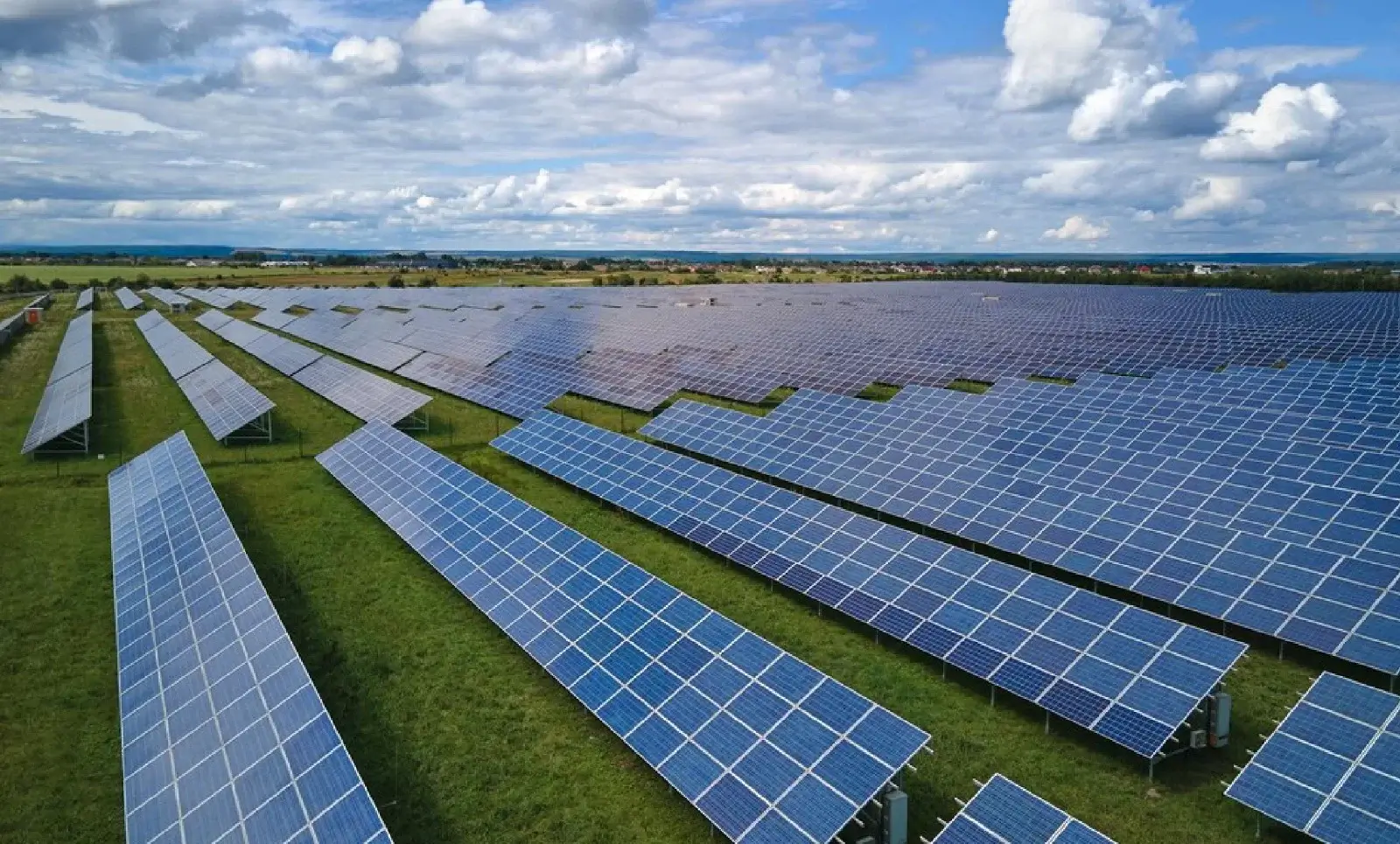
India’s solar policy environment supports both models. Several state governments, as well as central authorities, offer incentives, net metering policies, and open access support that make both OPEX and CAPEX models viable and attractive.
For instance, states like Karnataka, Maharashtra, and Tamil Nadu are known for investor-friendly open access frameworks that enable third-party PPAs under the OPEX model. Similarly, CAPEX model adopters benefit from accelerated depreciation under Section 32 of the Income Tax Act, and GST benefits.
Stay updated on these policies through Enerparc’s regulatory insights.
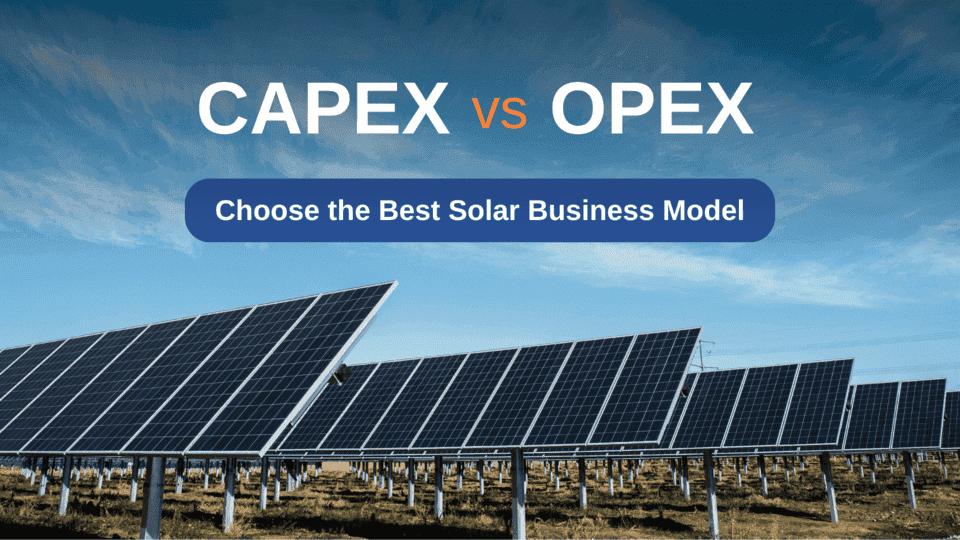
When choosing between CAPEX vs OPEX solar model, C&I consumers must evaluate:
1. Financial Strategy
– Do you have surplus capital to invest in non-core infrastructure?
– Are you looking for long-term asset ownership?
If yes, the CAPEX model aligns with your strategy. If not, OPEX may be more viable.
2. Operational Bandwidth
– Can your team manage maintenance and performance monitoring?
If not, OPEX allows you to outsource these responsibilities to experienced developers like Enerparc Energy.
3. Tariff Comparison
– Analyze the per-unit cost of electricity under PPA vs the levelized cost under CAPEX.
– Consider future tariff escalation clauses in OPEX contracts.
4. Risk Appetite
– CAPEX comes with performance and technology risk, while OPEX transfers that risk to the developer.
5. Sustainability Goals
– Both models help achieve ESG targets, but OPEX provides a faster route to decarbonization.
6. Tax Planning
– Want to maximize your tax savings through accelerated depreciation? CAPEX makes more sense here, as these benefits are only applicable when the solar plant is owned by the business.
Real-World Examples
At Enerparc Energy, we’ve served a range of clients—from automotive giants to global electronics manufacturers—under both OPEX and CAPEX models. For example:
– A leading electronics manufacturer chose the OPEX route for their multi-megawatt rooftop system to ensure zero upfront investment and immediate savings.
– On the other hand, a global FMCG brand adopted CAPEX to build its own on-site solar infrastructure as part of its long-term sustainability roadmap and to benefit from tax depreciation.
Discover more success stories through our project portfolio.
Read More: Ground Mount vs Rooftop Solar Systems
There is no one-size-fits-all approach in the OPEX model vs CAPEX model debate. Each has its strengths, and the choice should be driven by your organization’s financial posture, risk profile, and long-term sustainability vision.
Enerparc Energy offers tailored solar financing solutions to meet your unique business needs. Whether you’re ready to invest in a CAPEX solar asset or prefer the ease of an OPEX-based Power Purchase Agreement, our team helps you transition smoothly.
Start your solar journey with the model that suits you best. Schedule a one-on-one consultation today to explore the smartest solar strategy for your business.
In the CAPEX solar model, the consumer makes an upfront investment and owns the solar system. In the OPEX solar model, there is no upfront cost because the developer owns the system and supplies electricity to the consumer through a long term Power Purchase Agreement, also known as a PPA.
CAPEX generally delivers higher long-term savings, whereas OPEX provides immediate savings without the burden of ownership or maintenance.
In CAPEX, the owner (consumer) handles operations and maintenance. In OPEX, the developer manages all maintenance and performance responsibilities.
No. Tax benefits like accelerated depreciation apply only under the CAPEX model since the business owns the solar asset.
OPEX is ideal for businesses that prefer zero upfront investment and want a risk-free approach. It’s widely used in commercial and industrial sectors with high electricity consumption.
No. CAPEX typically results in a lower tariff over time, while OPEX involves a fixed PPA tariff that may include escalation clauses depending on the contract.
Both models support lower carbon footprints and help businesses align with ESG commitments. OPEX offers a quicker path to adoption due to its low entry barrier.
Yes. However, CAPEX expansion requires fresh investment, while OPEX scaling is usually easier with developer support.
Explore More: