
let’s preserve the environment by using solar panels
Contact Us 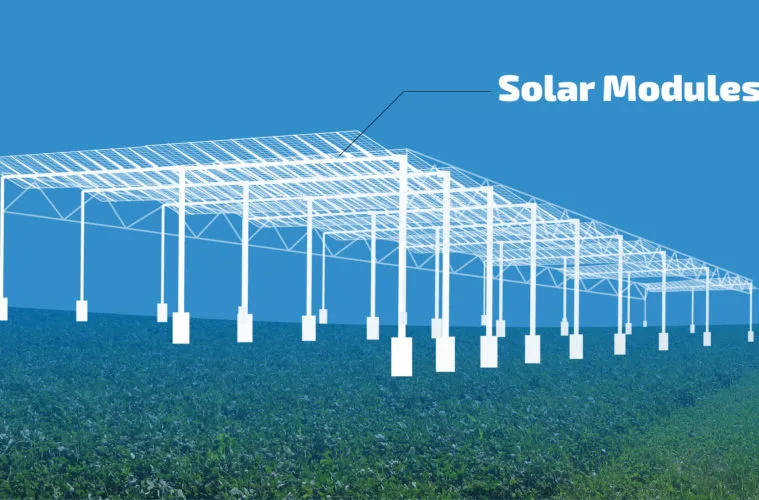
Agro PV (agrivoltaic) systems enable simultaneous solar power generation and crop cultivation on the same land, a sustainable answer to balancing clean energy with food production. Success depends on selecting low-growing crops, raising panel heights, and widening inter-row spacing to share sunlight, though these adjustments raise costs and reduce energy output. For agrarian, increasingly land-scarce India, Agro PV holds real promise, but careful cost-benefit analysis is needed to prove long-term viability for farmers and investors.
India has rapidly scaled its solar ambitions, having long surpassed its early 100 GW milestone cumulative installed solar capacity reached roughly 157 GW by mid-2026, with utility-scale ground-mounted plants the largest contributor. As one of the world’s leading agrarian nations, India now faces the challenge of balancing this solar development with food production driving growing interest in solar solutions that integrate with agriculture, commonly called Agro PV.
– Dual Land Use: Agro PV systems enable simultaneous solar power generation and crop cultivation, offering a sustainable land-use solution.
– Crop Selection Matters: Low-growing crops are essential to prevent shading and ensure both energy efficiency and agricultural productivity.
– Design Trade-offs: Adjustments like raising panel heights and increasing inter-row distances improve crop growth but can raise costs and reduce overall energy output.
– Global Inspiration: Successful pilots in Germany, Japan, and India provide insights for implementing agrivoltaic systems under varying climatic and farming conditions.
– Future Potential: Agro PV could play a key role in India’s clean energy strategy, but careful cost-benefit analysis is needed to ensure long-term feasibility for farmers and investors.
As one of the world’s leading agrarian nations, India faces the challenge of balancing solar development with food production. Leading solar energy companies in India are increasingly focused on implementing sustainable solar power solutions and adopting responsible land use practices to minimize disruption to fertile farmlands.
As per MNRE, in FY 2017-2018, ground mount solar plant installation stood at over 25 GWp, translating to approximately 500 sq km of land under solar modules. As the push to meet solar goals continues, there is growing emphasis on innovative solar energy solutions that integrate with agriculture, commonly referred to as Agro PV systems.
Globally, the idea of solar farms has been designed. An Agro PV project in Germany has had a successful pilot run, with winter wheat, potatoes, and celeriac being tested. Agro PV has also been undertaken in Japan. The heights of the installations vary from 2.5 to 3 m above the ground.
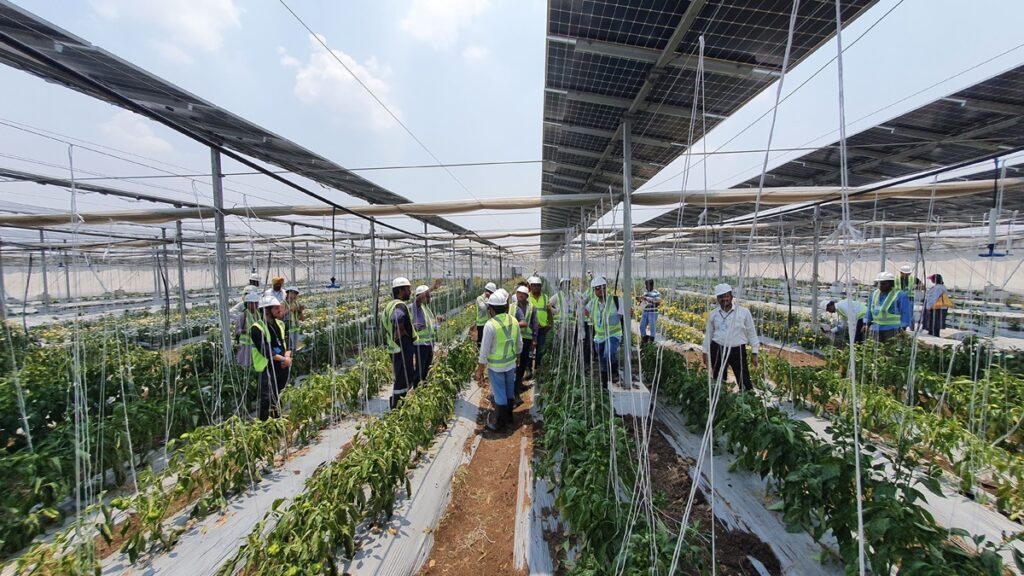
In India, ICAR has published its findings on an agro-PV system set up in Jodhpur. This study differs from its Japanese and German counterparts in that aspect allows for farming only in the inter-row spaces. The modules have not been raised to a greater height to allow for crop cultivation underneath the modules. Additionally, the pilot runs incorporated the use of a rainwater harvesting channel. As part of the mounting structure, a channel was placed at the bottom end of the panels to collect rainwater directly as well as from the drip of the modules.
Additionally, the pilot runs incorporated the use of a rainwater harvesting channel solar rainwater harvesting. As part of the mounting structure, a channel was placed at the bottom end of the panels to collect rainwater directly as well as from the drip of the modules solar mounting structure water collection.
Also Read: Exploring Spectral Response in Solar Modules for Enhanced Efficiency
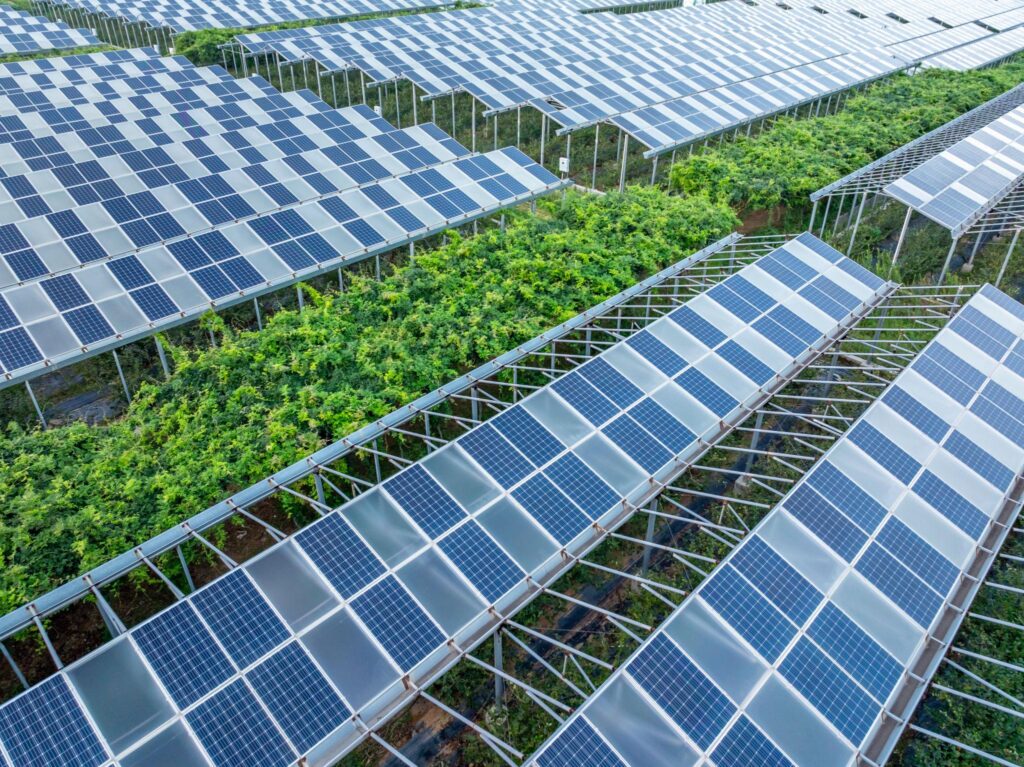
Agro PV employs expansive use of the land on which the solar power plant is installed in an agrivoltaics, agro-PV system. This would involve raising the height of the mounting structures to reduce the intensity of the shadows cast by the modules solar mounting height, agro-PV design. Raising the heights of the modules would also mean increasing the inter-row distance inter-row spacing in agro-PV. These changes to the standard design of a ground mount project would allow the surface below the modules, across the land area of the project, to receive relatively uniform levels of sunlight, solar light distribution, and agro-PV land use.
On the cost side, this design would also require additional expenses to account for the increase in material for the mounting structures, and also a reduction in the total power that the same piece of land could produce, had standard design practices been employed. However, crop yields under Agro PV systems remain lower than traditional farming, and large-scale viability still needs to be proven.
Also Read: Module Mounting Structures for Ground Mount Solar Installations
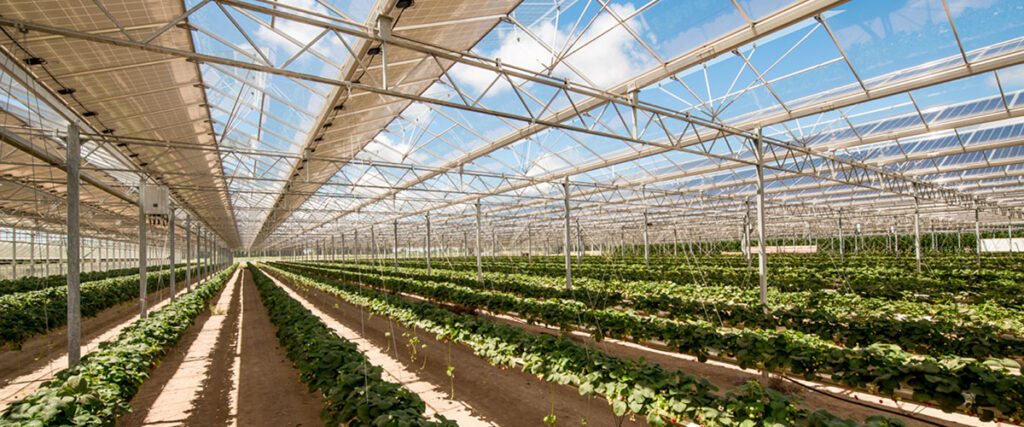
The future of agro PV will depend on the performance of both large-scale crops and solar power plants. If the additional costs are justified, and over time, their impact on power generation capacity. If the cost increases due to design changes that do not match the returns for farmers and investors, other ideas for effective land use will have to be explored.
As we shift into a land-scarce world, it is crucial to ensure that tracts of land are put to efficient use. In this effort, all viable options must be carefully examined before one is chosen to be translated into a utility-scale project.
Also Read : Benefits of Solar Energy for Business & Industry
Balancing solar energy growth with agricultural sustainability is essential for India’s clean energy future. Agro PV systems offer a viable path toward dual-use land optimization, but careful consideration of costs, design, and crop suitability is needed to realize their full potential.
Agro PV systems, also known as agrivoltaic systems, combine solar power generation with agricultural activities on the same land, allowing farmers to grow crops under and around solar panels.
India, being a leading agrarian nation with ambitious solar power targets, needs solutions that balance renewable energy generation with food production. Agro PV systems offer a sustainable way to achieve both goals.
Low-growing crops are generally suitable, as taller crops can shade solar panels and reduce electricity generation. Pilot projects in India have focused on crops that fit within inter-row spaces, similar to international examples in Germany and Japan.
Key challenges include optimizing panel height and inter-row distance to allow sufficient sunlight for crops, while maintaining efficient solar power output. Design adjustments can increase costs and may reduce total power generation per unit of land.
While Agro PV systems can provide dual land use, crop yields under these systems are generally lower than traditional farming. Large-scale economic viability is still being studied and depends on balancing investment costs with power generation and crop revenue.